
The AI landscape in early 2026 presents a striking contradiction. On one side, we see record-breaking investment and explosive user growth. On the other, most organizations are still struggling to realize meaningful returns. Understanding this paradox is essential for leaders charting their AI strategy.
The Numbers Tell Two Stories
Incredible Use
ChatGPT nears 900 million weekly active users, and Google's Gemini is rapidly catching up. AI tools are among the fastest-adopted technologies in history. The demand is real, and people are finding these tools genuinely useful in their daily lives.

Limited Return?
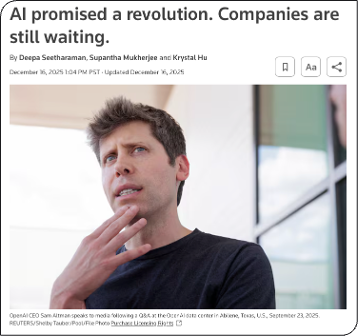
Despite this adoption, The Wall Street Journal reported in December 2025 that "AI promised a revolution. Companies are still waiting." Enterprises have poured enormous resources into AI initiatives, but many are not yet seeing the productivity gains they expected.
$405 Billion vs. 16%
These two numbers capture the paradox:
- $405 billion in committed AI capital expenditure in 2025 alone
- 16% global AI adoption rate (25% in the Global North), per Microsoft
The money is flowing in, but organizational adoption has not kept pace. Most institutions are still in the early stages of figuring out how to use AI effectively, not because the technology is lacking, but because the organizational change required is significant.
The CEO/Worker Divergence
A January 2026 Wall Street Journal study revealed a dramatic gap in how executives and workers perceive AI's value.
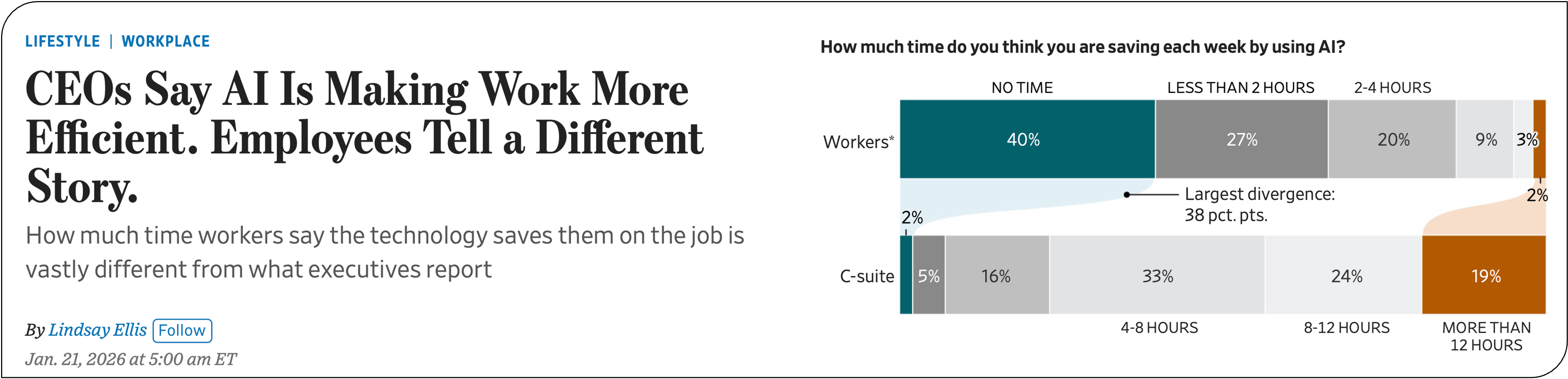
"CEOs Say AI Is Making Work More Efficient. Employees Tell a Different Story."
When asked how much time AI saves them each week:
- Workers: 40% said "no time at all," and another 27% said "less than 2 hours"
- C-suite: Only 5% said "no time," while 19% reported saving more than 12 hours per week
That is a 38 percentage point gap between leadership and the workforce on the most basic question: "Is this actually helping?"
This divergence matters because it reveals a fundamental disconnect. Leaders are enthusiastic, but their teams may not have the training, tools, or workflows to realize the same benefits. Bridging this gap requires intentional investment in training and change management, not just tool procurement.
The Workslop Epidemic
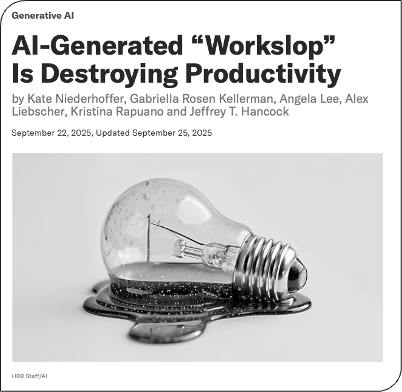
The term "workslop" was coined by Harvard Business Review in September 2025 to describe AI-generated work that is "unhelpful, low-effort, or low-quality." It is the inevitable result of encouraging AI use without providing proper training on how to use it well.
The Data is Sobering
In a survey asking "How much of the AI-generated work that you send to colleagues do you think is actually unhelpful, low-effort, or low-quality?":
- 30.3% said 0% (meaning they believe everything they send is quality)
- 20.3% admitted to 10% workslop
- 11.2% admitted to 20% workslop
- The remaining respondents acknowledged even higher percentages
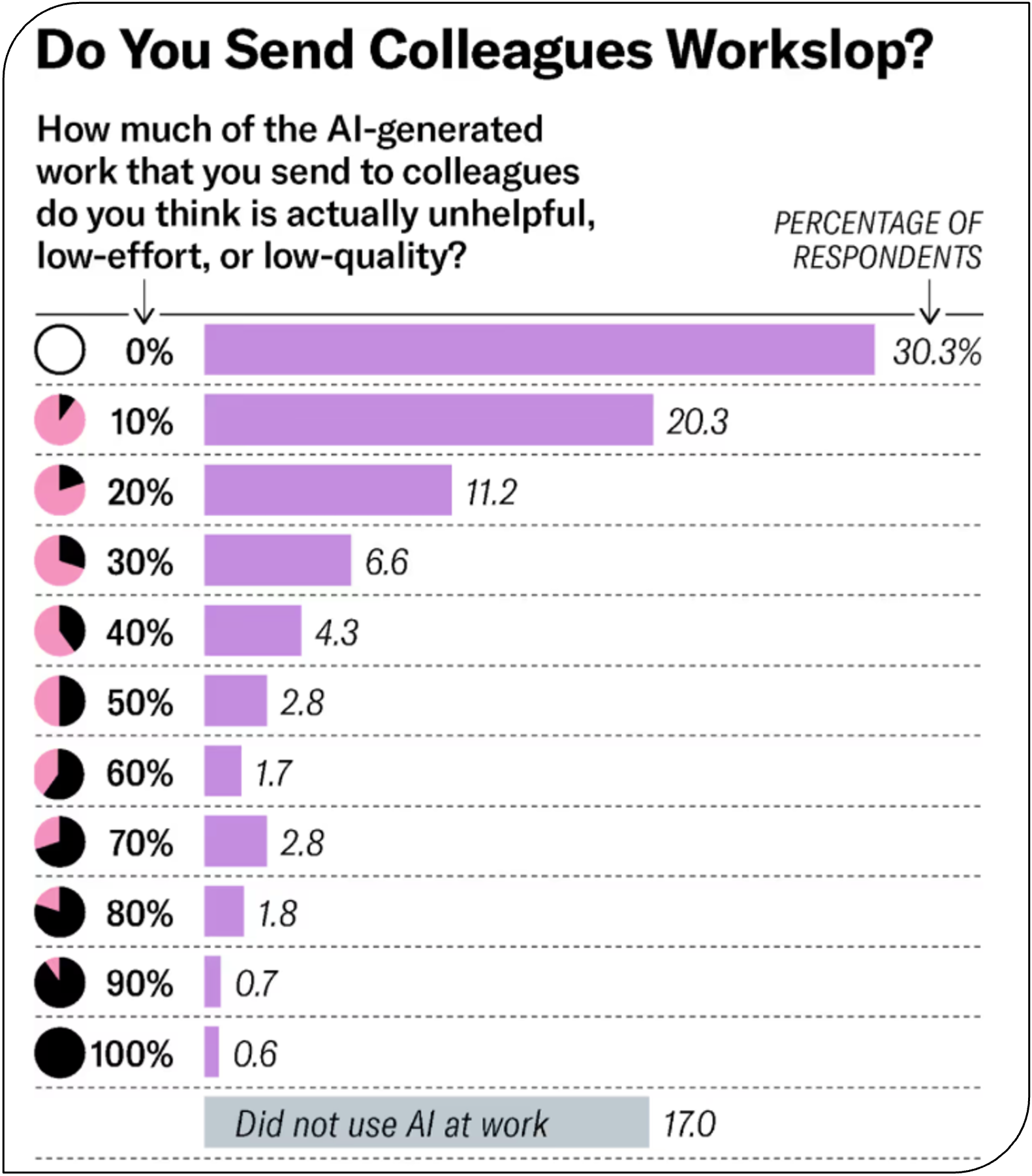
In other words, roughly 70% of AI users acknowledge that at least some of what they produce with AI and share with colleagues is subpar. That is a systemic quality problem.
Why This Matters for Your Institution
Encouraging staff to "just start using AI" without investment in training creates real risk:
- Credibility erosion: Colleagues begin to distrust AI-assisted work across the board
- Time displacement: Instead of saving time, people now spend time reviewing and correcting poor AI output
- Cultural damage: AI becomes associated with laziness rather than capability
- Decision quality: Important decisions may be informed by AI output that nobody verified
The solution is not to slow down AI adoption. It is to pair adoption with intentional training, clear quality standards, and a culture of ownership over AI-assisted work.
What This Means for Community College Leaders
The paradox is not a reason to wait. It is a reason to be strategic:
- Invest in training, not just tools. The gap between executives and workers closes with education, not enthusiasm alone.
- Set quality expectations early. Define what "good" AI-assisted work looks like before rolling out tools broadly.
- Start with high-value use cases. Demonstrate clear ROI through targeted pilots rather than broad, unfocused adoption.
- Measure what matters. Track actual time savings and quality improvements, not just license counts.
- Lead by example. When leaders demonstrate thoughtful, effective AI use, it sets the standard for everyone else.
The institutions that will succeed are not the ones that adopt AI fastest. They are the ones that adopt it most intentionally.